
What Is a Plotter?
A plotter is a computer-controlled printer that produces large, precise technical drawings (blueprints, maps, CAD files) on paper far wider than a standard printer can handle. Today's plotters use inkjet technology, but the name stuck around from a completely different machine. Here's what a plotter actually is, how it works, and why the term still means something specific.
A Quick History: Where Plotters Came From
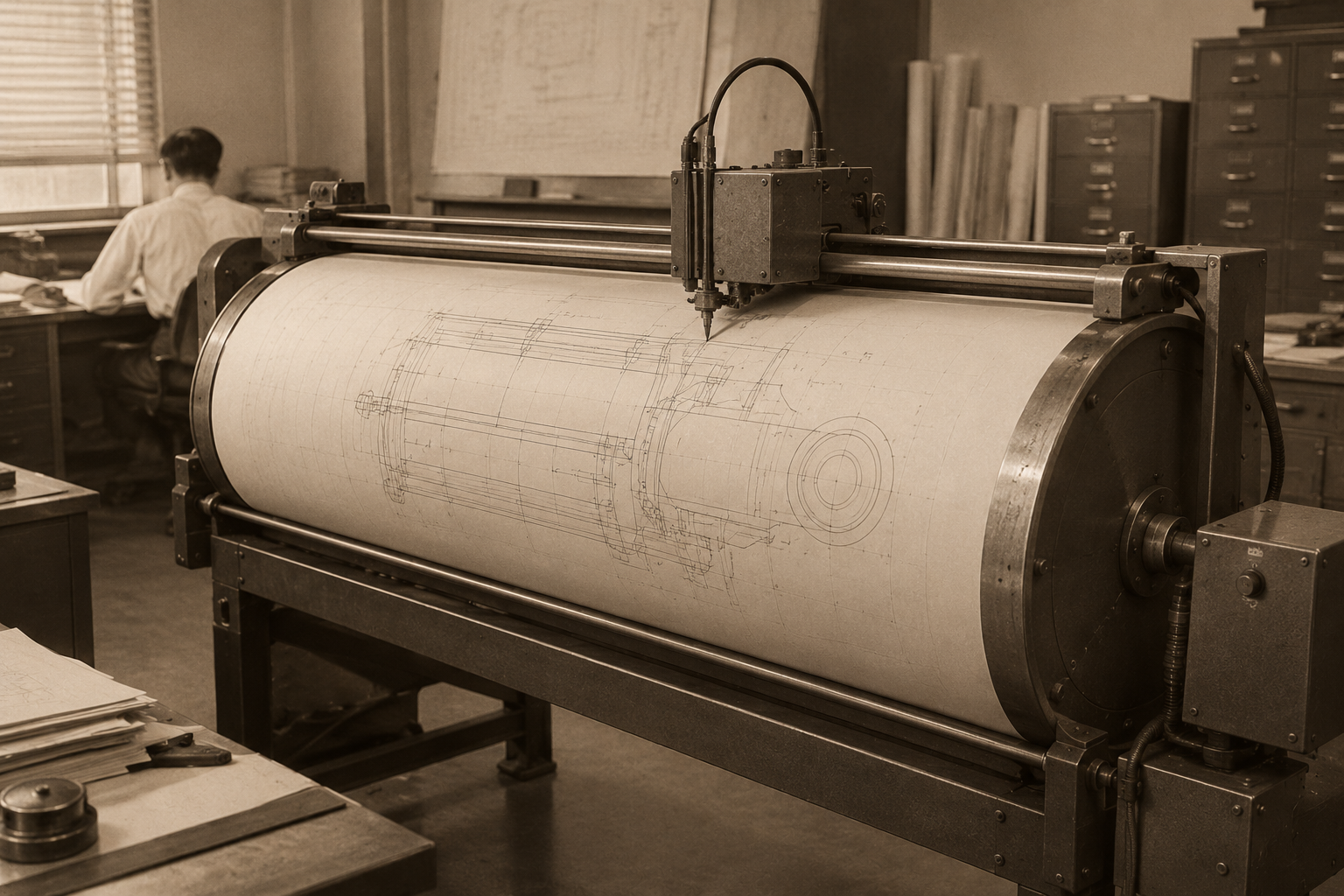
The first plotter was the CalComp 565, built in 1959 by two engineers working out of a converted tire store in Los Angeles. Their first pitch for a contract had already failed. They regrouped anyway and built a machine that could draw with a pen, guided entirely by computer commands.
It worked by feeding paper over a rotating drum. The drum moved the paper in one direction. A pen mounted on a track moved in the other direction. Together, they drew continuous lines instead of printing dots, precise enough for the era's engineering and architectural work.
HP entered the plotter business in 1968, with its first plotter, the 9125A: a flatbed model where the paper lay flat while the pen moved across it. It even made a brief appearance in the 1971 film The Andromeda Strain. HP moved to pen-carriage plotters in the late 1970s, then entered the large-format plotter market in 1981. Within six years, HP held close to half the market, overtaking CalComp as the category leader.
In 1988, HP introduced its 7600 series electrostatic plotters, which used charged toner instead of a pen and more closely resembled a photocopier. They didn't last long. In the early 1990s, HP replaced them with the first DesignJets: inkjet plotters that cost less to buy and run, and printed in a single pass instead of several. That's the same product line SBR sells and services today.
How a Plotter Works: Then and Now
Early plotters drew with a real, physical pen. The pen moved along two axes, tracing continuous vector lines directly onto paper. That's where the name comes from: the machine literally "plotted" a line from one point to another, the same way a navigator plots a course.
In between, electrostatic plotters used charged toner instead of ink, trading some precision for speed. Then inkjet took over for good. Modern plotters, including HP's DesignJet line, spray ink in fine dots; the same basic process a regular printer uses. The mechanism changed twice. The name and the use case never did.
Plotter vs. Printer: What's Actually Different

Historically, the difference was simple. A plotter drew vector lines: continuous and scalable to any size without losing sharpness. A printer built up raster images: dots, which get blockier the larger you stretch them. That's why a plotted blueprint held up at full scale, and a printed one didn't.
That distinction explains where the term came from. It doesn't fully explain what you're buying today.
Modern plotters are inkjet printers. The vector-versus-raster line has blurred. The purpose hasn't changed. A plotter is still built for technical, large-format work: CAD drawings, blueprints, site plans. A printer is still built for everyday documents: letters, reports, photos.
The real difference today isn't the mechanism inside the machine. It's what the machine is built to output, and how large it can output it. Wide-format plotters like the ones SBR sells handle paper rolls up to several feet wide. A standard printer tops out at a fraction of that.
What Is a Plotter Used For?
Architecture firms use plotters to print full-scale building plans, floor layouts, and elevations. These are drawings that need to be accurate down to the line weight, not just legible.
Engineering firms use them the same way, for structural drawings, mechanical schematics, and site plans that get carried to a job site and checked against real measurements.
Construction and AEC teams often print directly from a plotter onto a job site drawing set, since a full-size printed plan is still easier to mark up by hand than a screen.
GIS and mapping professionals use plotters for maps that need to hold scale and detail even at several feet across, something a standard printer physically can't produce.
Not All Plotters Print: Cutting Plotters vs. Wide-Format Plotters

One more distinction worth making: not every plotter prints. A cutting plotter uses a blade instead of ink to cut shapes out of vinyl, labels, or decals for signage. It's a real, common piece of equipment, but a different category entirely from the wide-format printing plotters this article is about.
If someone in a sign shop mentions a "plotter," they may mean the cutting kind. If an architect or engineer mentions one, they almost always mean the printing kind.
What Is Plotter Paper?

Plotter paper isn't just large paper. A handful of materials cover most real use:
Bond paper is the standard choice for everyday technical drawings; affordable and reliable for line work.
Coated bond holds ink better than plain bond, useful when a drawing includes finer detail or shading.
Vellum is translucent, often used for overlays or when a drawing needs to be checked against another sheet underneath it.
Polyester film, sometimes called Mylar, is durable and waterproof, used when a drawing needs to withstand job-site handling or long-term storage.
Photo or glossy paper is used for color renders and graphics rather than line drawings.
Sizes generally follow one of two standards in the U.S.: ANSI (A through E) or ARCH (A through E). Internationally, ISO sizes (A0 through A4) are more common.
Frequently Asked Questions
What does a plotter do?
It takes a digital file and prints it as a large-format drawing, using ink and precise, continuous movement across the page.
How does a plotter work?
Older plotters moved a pen across paper by hand. Modern plotters use inkjet technology and print fine dots with high precision.
What is a plotter used for?
Mainly architecture, engineering, construction, and mapping; anywhere a drawing needs to be accurate at full scale.
What's the difference between a printer and a plotter?
Today, both use similar inkjet technology. The real difference is purpose and size: plotters handle large-format technical drawings; printers handle everyday documents.
The Machine Changed. The Job Didn't.
A plotter started as a pen drawing lines on a spinning drum. It became a machine using charged toner. Today, it's an inkjet printer, built for the same job all along: turning a digital file into a large, accurate, full-scale drawing. The machine changed, twice. What it's for never did.

